Private Stablecoin on Ethereum
Private stablecoins on Ethereum combine trustless, permissionless issuance with confidential transactions, opening the door to privacy‑first DeFi applications and new use cases like confidential trading and selective disclosure.
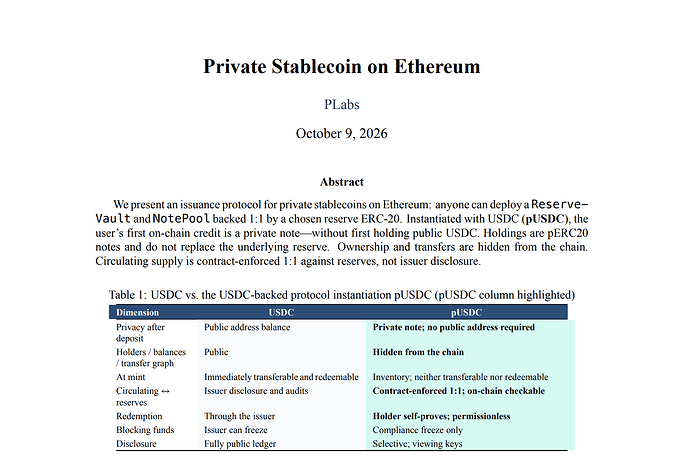
Private Stablecoins on Ethereum: Merging Stability with Privacy
Why Privacy Matters for Stablecoins
Stablecoins have become the backbone of decentralized finance (DeFi), offering a reliable unit of account and a bridge between fiat and crypto. Yet, their very transparency—every minting, redemption, and transfer is recorded on a public ledger—creates a new set of privacy concerns. Users who wish to keep their holdings, spending patterns, or trading strategies confidential are forced to rely on off‑chain solutions or layer‑2 privacy tools that add complexity and cost.
A privacy‑enabled stablecoin on Ethereum addresses these gaps by embedding confidentiality directly into the token’s core protocol. By leveraging zero‑knowledge proofs and confidential transaction primitives, such a stablecoin can keep balances, transaction amounts, and even the identities of participants hidden while still maintaining the trustless, permissionless nature of Ethereum.
Core Features of a Private Stablecoin
- Trustless Issuance and Redemption – Minting and burning are governed by smart contracts that enforce strict collateral backing (e.g., USDC or USDT). No central authority can arbitrarily inflate the supply.
- Permissionless Participation – Anyone can mint or redeem tokens as long as they meet the on‑chain collateral requirements. This removes gatekeepers and aligns with the ethos of open finance.
- DeFi Composability – The token can be used in existing lending, swapping, and yield‑generating protocols without modification, thanks to its ERC‑20 compatibility.
- Confidential Transactions – Zero‑knowledge proofs hide transaction amounts and participant addresses, ensuring that on‑chain data remains unlinkable to real‑world identities.
- Selective Disclosure – Users can prove specific facts—such as a minimum balance or a transaction’s validity—to auditors or regulators without revealing the underlying data.
- Native Private DeFi – Developers can build privacy‑first applications (e.g., confidential lending or anonymous prediction markets) from the ground up, rather than patching privacy onto existing protocols.
Emerging Use Cases
- Confidential Trading Strategies – Traders can execute complex strategies without exposing them to front‑runners or competitors.
- Social Trading with Reputation – By selectively sharing performance metrics, traders can build reputations and enable copy‑trading while preserving privacy.
- Private Prediction Markets – Participants can stake on outcomes without revealing their identities or the size of their positions, reducing manipulation.
- Regulatory Compliance – Selective disclosure allows compliance with Know‑Your‑Customer (KYC) and Anti‑Money‑Laundering (AML) regulations without compromising user privacy.
Practical Takeaway
A private stablecoin on Ethereum offers the same economic benefits as its public counterparts—stable value, trustless governance, and ecosystem integration—while adding a layer of confidentiality that is increasingly demanded by users, regulators, and sophisticated traders. As the DeFi landscape matures, privacy‑first stablecoins could become a foundational building block, enabling new financial products that respect both openness and anonymity.
TL;DR
Private stablecoins on Ethereum combine trustless, permissionless issuance with confidential transactions, opening the door to privacy‑first DeFi applications and new use cases like confidential trading and selective disclosure.
Source
Read original sourceWhy we picked this
Peer-reviewed research paper on a privacy-enabled stablecoin protocol, offering primary technical insights.