One year after 10/10 flash crash, bitcoin and ether liquidity have rebuilt, but altcoins still face risks
A year after the 10/10 flash crash, Bitcoin and Ether liquidity has rebounded, while altcoin liquidity and spot trading remain weak.
Introduction
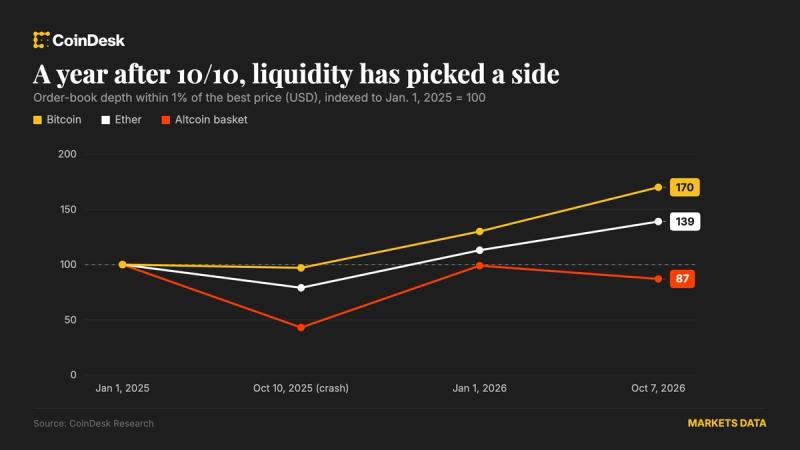
One year after the $19 billion flash crash that ripped through crypto markets on October 10, 2025, the liquidity landscape has changed dramatically. Data from CoinDesk Research shows that the order books for Bitcoin (BTC) and Ether (ETH) are now deeper than they were on the crash day and even deeper than at the start of 2025. In contrast, the broader altcoin universe has seen a steady erosion of dollar‑denominated depth, and weekly spot‑trading volume on centralized exchanges remains well below its pre‑crash peak.
Bitcoin and Ether: Rebuilt Depth
Liquidity depth measures the value of buy and sell orders that sit close to the current price. A deeper book allows large trades to be absorbed with minimal price impact.
- Bitcoin: As of early October 2026, roughly $11.7 million of BTC orders sit within 1 % of the price—about 75 % more than on the crash day and higher than the $9 million recorded at the start of 2025. Because BTC is now priced about one‑third lower than before the crash, this increase reflects genuine capital commitment by market makers, not just a price effect.
- Ether: ETH’s tightest liquidity band (within 0.5 % of price) has more than doubled since the crash, reaching about $4.2 million. At the 1 % band, depth is up roughly 75 % to $5.3 million, surpassing both January 2025 and January 2026 levels.
These improvements are concentrated near the current price, where market makers are most active. The deeper books suggest that institutional participants have returned to the majors, restoring a key piece of market infrastructure that was lost in the flash crash.
Altcoins: A Diverging Trend
The picture for smaller tokens tells a different story. CoinDesk’s basket of altcoins shows:
- Dollar‑denominated depth has been on a downward trajectory since early 2025. At the 5 % price band, depth is down about one‑third compared to January 2025, and at the 1 % band it has fallen roughly one‑sixth.
- Token‑unit depth appears healthier because falling prices mask the loss of capital. While the number of tokens quoted in order books has not dropped dramatically, the dollar value behind those orders has.
Analysts note that this divergence reflects a shift in market‑maker focus toward assets with clearer institutional demand. Outside a handful of high‑profile alts, liquidity is expected to stay subdued into the next year.
Spot Trading Volume Remains Low
Even though order‑book depth for BTC and ETH has recovered, overall spot‑trading activity has not. Weekly spot volume on centralized exchanges averaged $279 billion over the four weeks ending September 27, 2026—about two‑thirds lower than the $801 billion seen during the crash week. Volume bottomed out in August at roughly $135 billion but has since doubled, still far short of pre‑crash levels.
The muted spot market underscores that while market makers have re‑entered the major pairs, broader trader participation has not fully returned. This gap could limit price discovery and keep volatility elevated for smaller assets.
What It Means for Investors
- Majors are back: Bitcoin and Ether now enjoy robust liquidity, making large‑scale trades less likely to trigger sharp moves. This stability can encourage more institutional allocation to the top‑tier assets.
- Altcoins face headwinds: Reduced dollar depth and low spot volume suggest higher price impact for trades in smaller tokens. Investors should expect wider spreads and potentially higher volatility.
- Strategic positioning: Diversified portfolios may benefit from a core exposure to BTC and ETH, complemented by selective altcoin positions where liquidity remains sufficient.
Conclusion
The flash crash of October 2025 exposed how fragile crypto market infrastructure can be. A year later, the plumbing for Bitcoin and Ether has been rebuilt, with deeper order books and renewed market‑maker confidence. However, the broader altcoin market has not kept pace; declining dollar depth and subdued spot trading indicate lingering risk. As liquidity continues to concentrate in the majors, investors should monitor depth metrics and volume trends to gauge where capital is flowing and where caution remains warranted.
Source
Read original sourceWhy we picked this
Provides on‑chain liquidity data post‑crash, useful for builders and operators