How Much Screening Buys a Second? Speed, Selection, and the Maker's Spread
A one‑second reduction in quote staleness saves roughly 84‑85% of the informed order flow that a twelve‑second AMM must screen to stay competitive.
How Much Screening Buys a Second?
Liquidity providers on automated market makers (AMMs) face a trade‑off: they can either quote faster (reducing the time a price is stale) or screen incoming flow to reject orders that are likely to be informed. This article distills the key insights from recent research on the economics of that trade‑off, focusing on USDC‑WETH pools on Ethereum and a Binance ETH‑USDT benchmark.
---
1. Why Staleness Matters
An AMM’s quote is a deterministic price derived from its reserves. Between trades the quote does not update, so on a blockchain that finalises blocks roughly every twelve seconds the posted price can be stale for an entire block. An arbitrageur watching a faster venue can exploit any price movement that occurs during that interval, effectively exercising an option written by the liquidity provider (LP).
The LP’s profit comes from two sources:
- Uninformed traders who trade for liquidity and pay the spread.
- Informed traders who know the direction of the price move and capture the spread.
The competitive spread is the width at which the loss to informed traders is exactly offset by the earnings from uninformed traders. Faster quoting reduces the exposure horizon, shrinking the expected loss from informed trades. Screening, on the other hand, rejects a fraction \(\eta\) of informed orders while keeping all uninformed flow.
---
2. The Break‑Even Screening Threshold
The paper derives a simple condition for when a slower, screened maker can match the spread of a faster, unscreened maker. Let:
- \(h_0\) be the exposure horizon of the fast reference maker (1 s).
- \(h_P\) be the horizon of the slower maker (12 s).
- \(\theta\) be the fraction of flow that is informed.
- \(Ah(s) = \mathbb{E}[(|Zh|-s)+]\) be the expected loss from informed trades when the half‑spread is \(s\) and the price innovation over horizon \(h\) is \(Zh\).
The critical screening level is \[ \eta{\text{crit}} = 1 - \frac{A{h0}(s0)}{A{hP}(s0)} \] where \(s0\) is the spread that the fast maker would charge without screening. If the slower maker screens more than \(\eta_{\text{crit}}\), it can quote a narrower spread than the fast maker; if it screens less, its spread must be wider.
Crucially, the threshold depends only on the ratio of horizons and the informed share, not on volatility, fee level, or trade size. This scale‑free property makes the result robust across assets and market conditions.
---
3. Empirical Findings from USDC‑WETH Pools
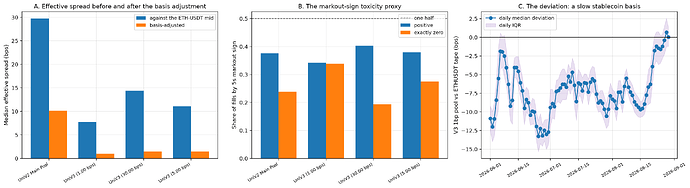
Using Binance ETH‑USDT mid‑price data (June‑August 2026) and on‑chain swap logs from four USDC‑WETH pools (Uniswap v2 and v3), the study measured:
- Innovation distribution: 73 % of one‑second intervals show no price change; the excess kurtosis is 154, indicating heavy tails.
- Spread reduction from faster quoting: Moving from a 12‑second to a 1‑second cadence removes 84.5 % of the expected informed‑order loss.
- Screening requirement: To achieve the same spread as a 1‑second maker, a 12‑second pool must screen at least 84.5 %–85.2 % of informed flow, far above the 71.1 % implied by a Gaussian price‑move model.
- Trend effects: In seconds where the benchmark drift exceeds 10 bps (≈11 % of time), pools that fill with the trend enjoy an effective spread about 11 bps lower than those that fill against the trend.
- Elasticity of loss: The extra loss a stale pool must absorb grows with elapsed staleness at an elasticity of roughly 0.45, close to the diffusion rate of ½.
These results highlight that fat‑tailed price moves dramatically increase the value of faster quoting, and that any realistic screening system must be extremely aggressive to compensate for a twelve‑second exposure.
---
4. Practical Takeaways for Makers
- Prioritise latency where possible. Reducing quote exposure from 12 s to 1 s yields a spread advantage that would otherwise require screening out six out of seven informed orders.
- Design aggressive screening filters. If latency cannot be improved (e.g., on permissionless pools), the screening algorithm should aim for a rejection rate above 85 % of trades flagged as potentially informed.
- Re‑center quotes on expected price. Predictable drift widens a quote held at the current reference, but centering the quote on the expected reference (current price plus drift × horizon) eliminates the drift cost.
- Monitor market regime. During trending periods, the direction of the trend determines whether a stale quote is a liability or an asset; makers can adjust spread or screening aggressiveness dynamically.
---
Closing Thoughts
The research demonstrates that time is a powerful lever for AMM liquidity providers. A single second of reduced staleness can offset the need for near‑perfect screening, but only because price innovations are highly non‑Gaussian. Makers that cannot shorten their exposure horizon must accept the steep cost of screening—rejecting the vast majority of informed flow—to stay competitive. Understanding the exact trade‑off, as captured by the critical screening threshold, equips protocol designers and market makers with a clear metric for balancing speed, risk, and profitability.
Source
Read original sourceWhy we picked this
In‑depth, source‑linked research on maker market dynamics and USDC‑WETH pools provides concrete on‑chain evidence valuable to builders and researchers.