How large can EIP-8141's validation budget be? A mempool DoS benchmark
EIP‑8141’s 100 k gas validation cap is too low for many advanced use‑cases, and raising it to 300 k is safe only with client‑side protections that pause validation during block processing.
How Large Can EIP‑8141’s Validation Budget Be?
TL;DR – The current `MAXVERIFYGAS` limit of 100 k gas per frame transaction blocks important privacy and post‑quantum schemes. Raising the cap to 300 k gas is feasible, but only if the client temporarily suspends mempool validation while importing or building a block; otherwise the extra CPU can delay block processing enough to cause missed attestations.
---
1. Why the 100 k Cap Matters
EIP‑8141 introduces frames that allow arbitrary EVM code to run during transaction verification. Unlike the cheap `ecrecover` check in legacy transactions, a frame’s `VERIFY` step can be arbitrarily expensive. To prevent a denial‑of‑service (DoS) vector—where an attacker sends failing transactions that consume CPU for free—the spec caps unpaid validation at `MAXVERIFYGAS` (currently 100 k).
Unfortunately, many emerging use‑cases exceed this budget:
| Scheme | Approx. VERIFY gas | |--------|-------------------| | Groth16 shielded transfer | ~212 k | | PLONK verifier | ~298 k | | SPHINCS+ (hash‑based) | 94 k‑276 k | | BLS signatures (EIP‑7951) | 130‑140 k | | Lattice‑based post‑quantum (ML‑DSA‑44) | >1 M |
Thus, a higher cap is required for privacy, post‑quantum, and advanced multi‑signature wallets to be practical.
---
2. Benchmark Methodology
We evaluated the impact of raising `MAXVERIFYGAS` on a Nethermind node running the EIP‑8141 validation logic. Three hardware tiers were used:
- High – AMD EPYC 4344P (8 c/16 t), representing a local block builder.
- Mid – GCE c2‑standard‑8 (4 c/8 t), a typical validator.
- Low – GCE n1‑standard‑8 (4 c/8 t), approximating a full‑node with limited spare CPU.
Two worst‑case failing‑transaction payloads were crafted:
- Keccak‑wide – Repeated `KECCAK256` over 4 KB until the gas budget is exhausted.
- Sig‑stuffed – Sequential `secp256k1` signature verifications, with the final signature failing.
For each cap (100 k, 250 k, 300 k, 400 k, 500 k) we flooded the node with a steady stream of such transactions, measuring:
- Block‑import delay – Extra time to import a median mainnet block.
- Block‑building delay – Extra time for a proposer to assemble a block.
- Honest transaction admission – Fraction of legitimate frame transactions that still enter the mempool under load.
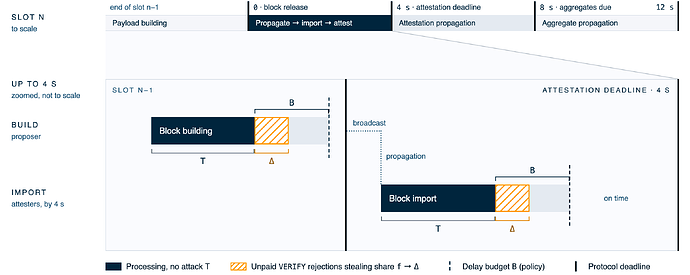
A safe load is defined as keeping the added delay ≤ 25 ms, which corresponds to a ≤ 0.2 % increase in missed attestation deadlines on today’s network.
---
3. Key Findings
| Machine | Safe gas‑per‑second (validation) | Cap that stays within 25 ms at 100 tx/s | |---------|--------------------------------|------------------------------------------| | High (builder) | ~30 M gas/s | 300 k (with client protection) | | Low (full node) | ~15 M gas/s | 100 k (no protection) |
- Without protections the node processes roughly 100 failing transactions per second per connection. At a 300 k cap this translates to 30 M gas/s, which exceeds the low‑tier node’s 15 M gas/s budget, causing > 25 ms block‑import delay.
- With in‑client mitigation (pause validation while a block is being imported or built) the effective CPU share taken by validation drops dramatically. Import delay falls to ≈ 2 ms even on the slowest machine, allowing a 300 k cap to stay within budget at 100 tx/s.
- Honest transaction admission suffers under heavy flood. At 100 tx/s with a 300 k cap, the low‑tier node admits only 12 %–27 % of honest frame transactions, indicating a trade‑off between higher caps and mempool throughput.
---
4. Practical Recommendations
- Raise `MAXVERIFYGAS` to 300 k – This accommodates most privacy and post‑quantum schemes while keeping the validation budget within a realistic range.
- Implement a validation pause – Clients should suspend frame validation while importing or building a block. Nethermind’s `#13994` patch demonstrates a simple and effective approach.
- Rate‑limit failing transactions per connection – Limiting to ~100 failing tx/s per peer reduces the attack surface without harming normal traffic.
- Monitor mempool health – Nodes should expose metrics on validation CPU usage and honest‑tx admission rates, allowing operators to adjust limits dynamically.
---
5. Conclusion
The 100 k gas cap in EIP‑8141 is a bottleneck for advanced cryptographic use‑cases. Our benchmarks show that a 300 k cap can be safely adopted, provided clients employ a lightweight mitigation that yields CPU to block processing during critical phases. This balances the need for richer verification logic with the network’s resilience against DoS attacks.
Source
Read original sourceWhy we picked this
Technical benchmark of EIP‑8141 validation budget with on‑chain implications for protocol security.